
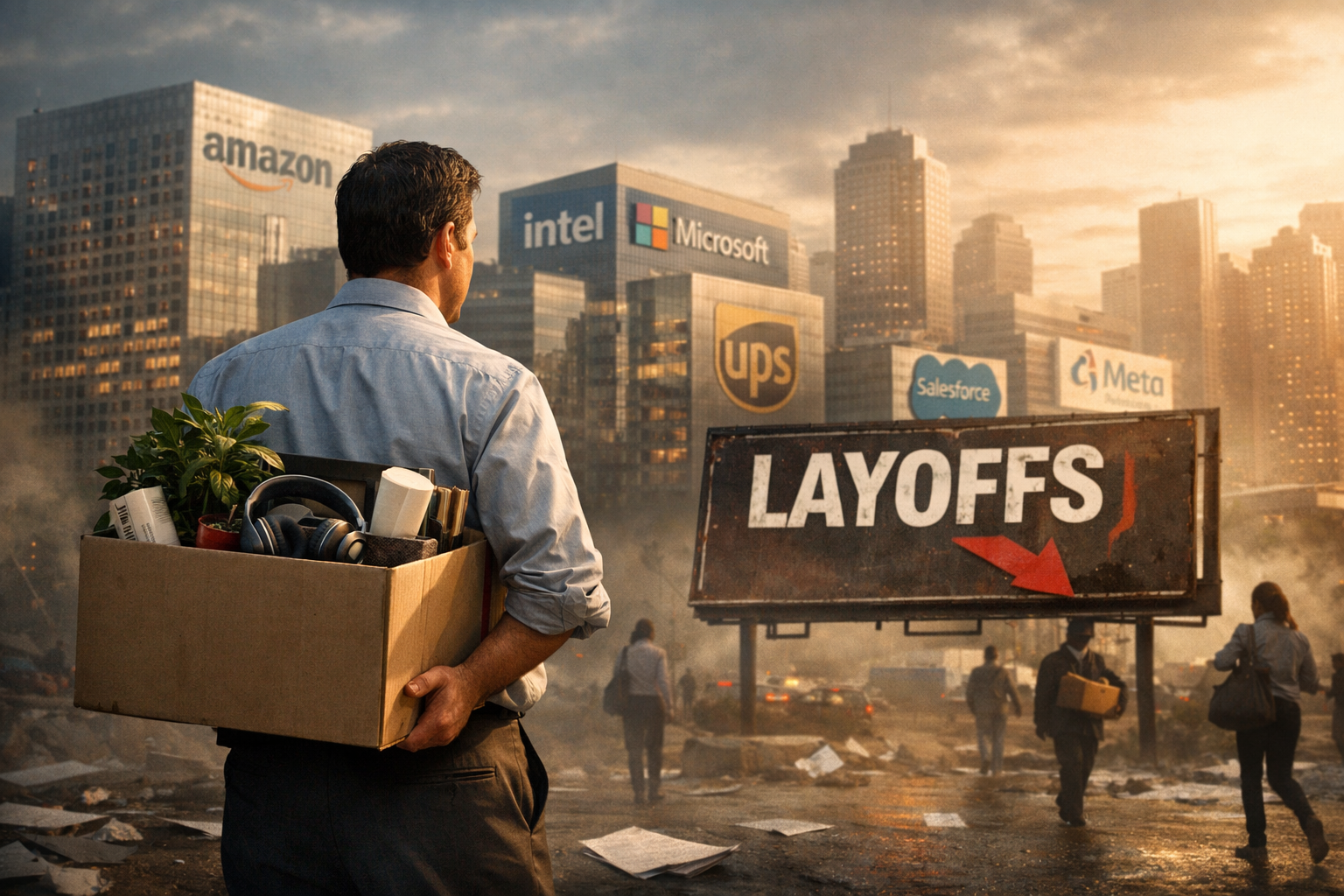
A Brutal Year for U.S. Workers
For millions of Americans, 2025 has become a year defined by layoffs. After years of aggressive hiring to meet pandemic-era demand, many corporations are now confronting the reality of overextended payrolls and overly optimistic growth projections. As markets cooled and borrowing costs remained elevated, executives moved quickly to downsize, often framing the cuts as “right-sizing” or efficiency measures.
The wave of job losses has been especially severe in large corporations, where entire teams built during the pandemic boom were suddenly deemed excess. In many cases, companies acknowledged they had staffed for growth that never materialized. At the same time, rapid advances in artificial intelligence and automation accelerated decisions to eliminate roles once considered essential, particularly in corporate, administrative, and technical functions.
While layoffs span multiple industries, the common thread has been a sharp pivot away from expansion toward cost control. For workers, the impact has been deeply personal — careers disrupted not by poor performance, but by sweeping strategic reversals. As 2025 comes to a close, the labor market reflects a painful correction to the excesses of the pandemic hiring surge and a clear signal that automation will play a larger role in shaping the future of work.
Top 10 Biggest Corporate Layoffs in the U.S. (2025)
(Approximate job cuts announced)
Amazon – ~30,000
Intel – ~24,000
United Parcel Service (UPS) – ~20,000+
Microsoft – ~10,000
Tata Consultancy Services (U.S. impact) – ~10,000
Salesforce – ~8,000
Procter & Gamble – ~7,000
Cisco – ~5,000
Applied Materials – ~1,400
Meta – ~1,000
Change is constant, and it's coming. There will always be a tomorrow, no matter how much you may try to ignore it. There are no guarantees in life, nor promises of a bright future. We see good people being laid off through no fault of their own. Just because something terrible hasn't happened yet doesn't mean it won't. It can happen to anyone, at any time, anywhere. No one is guaranteed to wake up tomorrow and still have a job by evening. While many employees can read the writing on the wall, why do most assume it’s targeted at someone else? Are you now wondering, Am I Next?