ADOBE FLASH - DISRUPTING THE STATUS QUO

Am I Next? Adobe Flash End of Life 2020

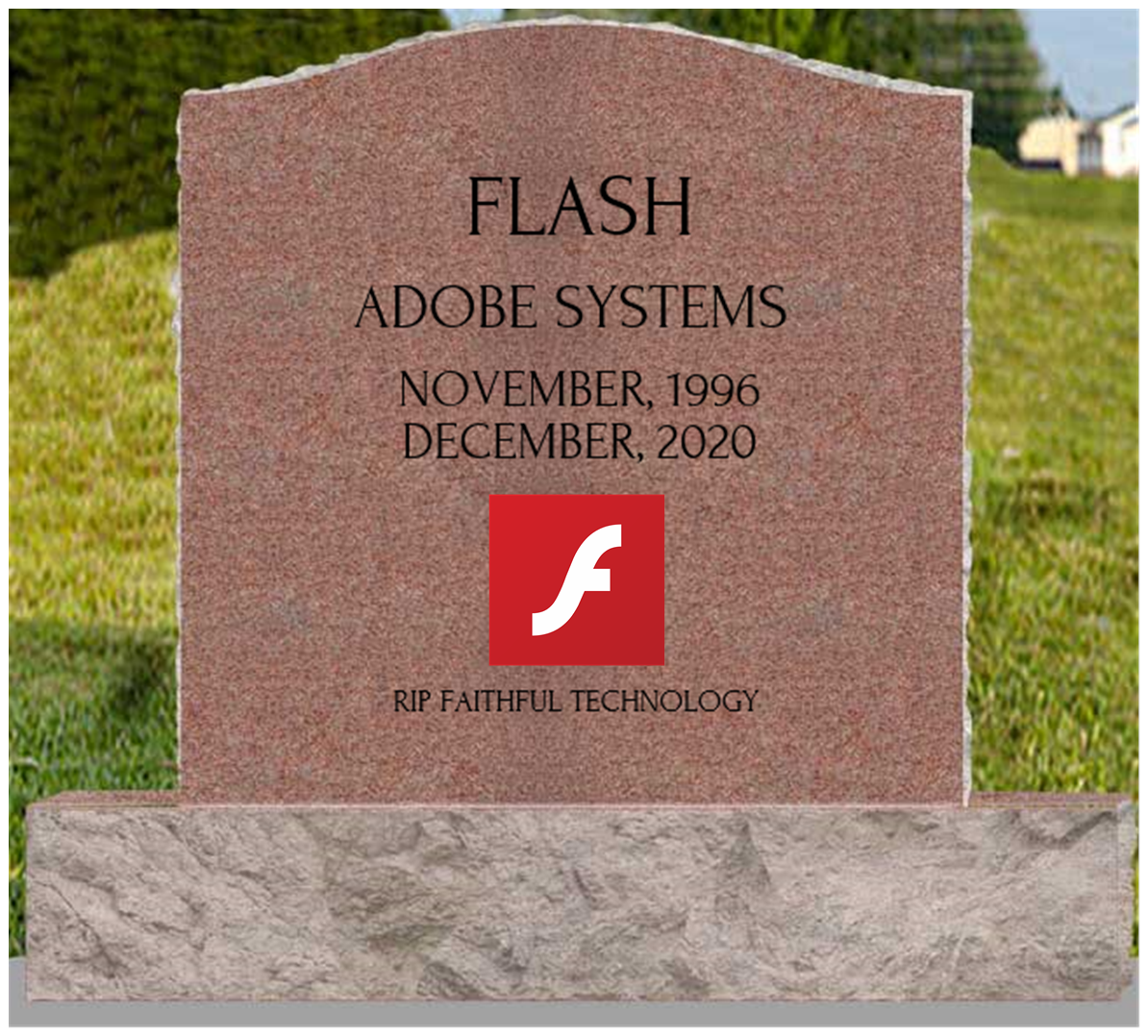
It appears that Adobe Systems has announced the end of life for its iconic Flash product by the end of 2020, giving web developers who relied on this ground-breaking technology to deliver content across multiple platforms with a degree of fidelity and clarity that was not widely available from other sources at the time. While the Flash product has posed security risks and interoperability issues, it was Apple’s apparent decision not to allow Flash to be incorporated into its ubiquitous platforms that was apparently the deciding factor in killing the product. Look forward to seeing new products that include the open web standards such as HTML5, WebGL, and WebAssembly.

Considering the number of times that I had to uninstall, reinstall, and update my systems with the latest versions of Flash, I cannot say that I would not welcome a newer, more stable product capable of displaying my content with the fidelity I believe provides for an excellent user experience. There are few products like Adobe’s Portable Document Format (PDF) – now a freely available open standard – to display documents on so many platforms and devices.  Flash has served its purpose and now its time has come to be replaced with better technological solutions.

However, one must consider the impact on the hundreds of thousands of websites and millions of browsers that currently use Flash. Not to mention the video games, educational programs, and advertising which rely on the Flash product. Like all disruptive technologies, this one has a golden lining – producing additional business for those who will be able to redesign, re-engineer, and re-code existing sites to the newer standards.

For those who want to follow the Flash story, the original Adobe announcement can be found at Flash & The Future of Interactive Content | Adobe. Steve Jobs’ 2010 Flash-killer comments can be found at Thoughts on Flash – Apple.  And a personal recollection from Stacy Jones at Fortune can be found at Adobe Flash Player: What Coders Can Learn From This | Fortune.com.

Disruptive technologies can appear out of the blue, but there are always signs of the coming impact if one is attuned to the trade press and company announcements. While the majority of breathless announcements of breakthroughs and paradigm-shifting technologies are mere puffery, serious comments from people like Apple’s Steve Jobs and Oracle’s Larry Ellison should be taken more seriously.

I would like to close this post with one of my favorite Steve Jobs jokes, which is truer than not. How many Apple programmers are needed to change a light bulb? What’s a light bulb, you mean the iLight?  Even more close to the truth is the Bill Gates version for Microsoft programmers: none, Bill Gates has declared “dark” to be the new standard.


SOLUTIONS: ENGINEERING , COMMON NEED, AND COMMUNITY

I thought I would share a wonderful video that demonstrates the ancient technology of the Inca Indians, common need, and a sense of community purpose.  This is an amazing story that should serve as a guideline for the many projects that exist around our nation, especially within the decaying inner cities. The moral of the story is: "Where there is a will, there is a way."

Produced for the exhibition "The Great Inka Road: Engineering an Empire" (http://americanindian.si.edu/inkaroad/), on view at the National Museum of the American Indian in Washington, D.C., through June 1, 2018. Every year, local communities on either side of the Apurimac River Canyon use traditional Inka engineering techniques to rebuild the Q'eswachaka Bridge. The old bridge is taken down and the new bridge is built in only three days. The bridge has been rebuilt in this same location continually since the time of the Inka. This video is narrated by John Ochsendorf, professor of civil engineering, Massachusetts Institute of Technology, and produced by Noonday Films.


NO LOVE AT THE JSE

You have to love those corporate-speak weasel words …

The JSE, formerly the Johannesburg Stock Exchange, rebranded itself with one of those made-by committee logos in 2014, claiming that "its new brand demonstrates the bourse's identity as a modern African marketplace that connects investors to growth opportunities globally.”

Am I Next? JSE Job Loss

It is now 2017 and the word is, “In addition, on a macro-economic level, the country continues to be plagued with low economic growth, rating downgrades and a loss of business confidence.  This has negatively impacted market activity.

“The JSE says it will cut its workforce by 14% as part of a cost cutting programme which will include reducing its technology operating expenditure by a minimum of R70 million over a two-year period.

"Nicky Newton-King, CEO of JSE said: 'globally, securities exchanges and other players in the financial services industry are adjusting the way in which they operate in response to changing regulatory requirements and the fast-pace of technological developments. The fast moving nature of our business requires us to change the way in which we operate so that we are as nimble and as cost effective as possible.  We cannot do so without significantly rethinking our cost base, our operating model and the way we are structured as a business,' Newton-King said."

One, if the company were truly global, one would expect that there are opportunities somewhere in the world that would be of interest to the moneyed individuals and companies and their flight capital to safety; and two, I just can’t help but think that it’s somehow related to that ugly logo. 

Are you asking yourself, Am I Next?