
The AI Layoff Narrative Versus The Data
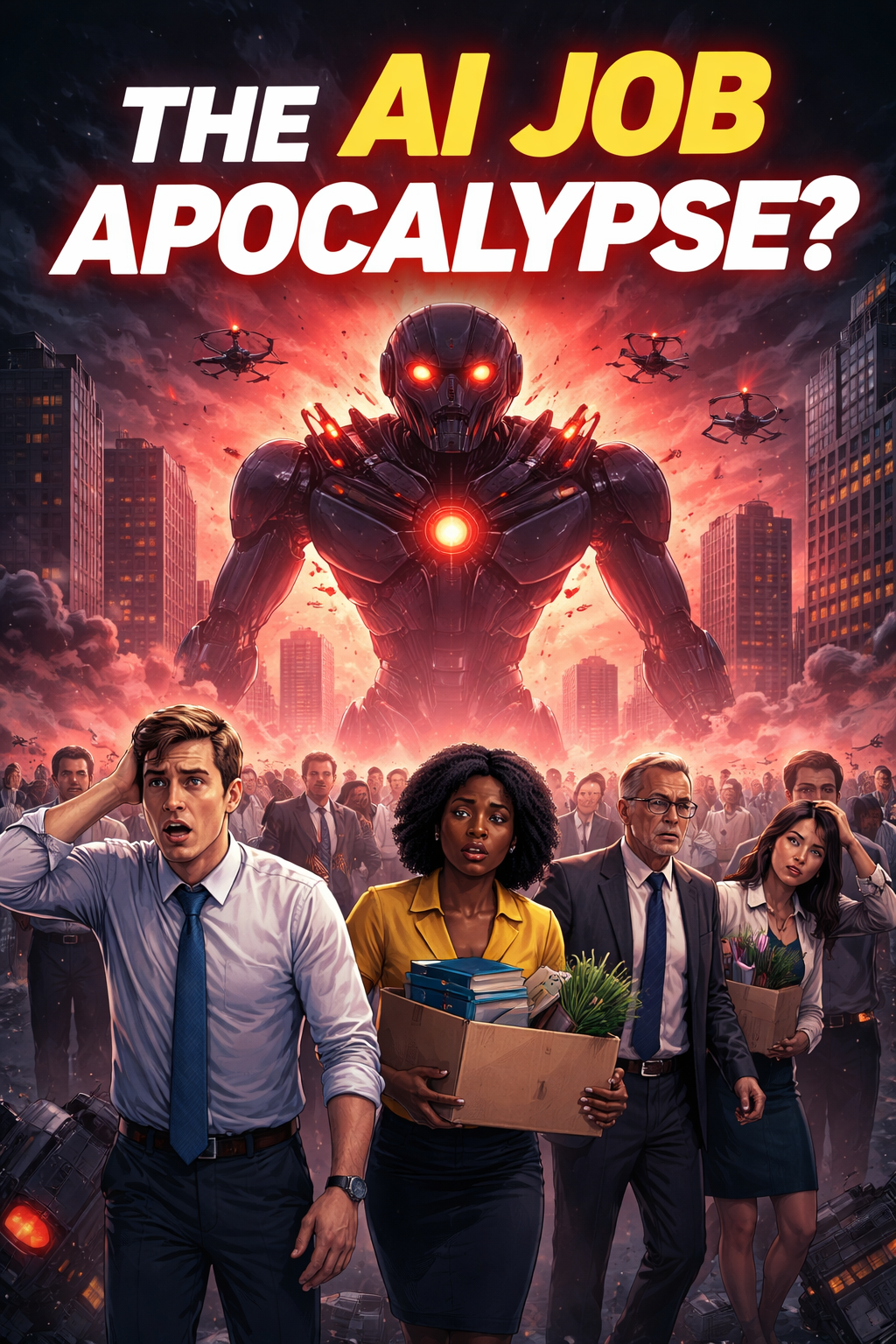
Ever since the launch of ChatGPT, headlines have warned that artificial intelligence is coming for everyone’s job. Tech CEOs go on television predicting mass unemployment. Analysts warn of a white-collar bloodbath. Students reconsider career paths.
But four years into the AI boom, the numbers tell a calmer story.
In 2025, consulting firm Challenger reported that AI was blamed for 55,000 layoffs in the United States. That sounds dramatic—until you add context. There were over 1 million total layoffs that year. AI accounted for roughly 5% of them. And even that figure reflects what companies said, not verified job replacements.
When firms overhire or restructure, attributing cuts to AI can sound more strategic than admitting operational mistakes. “We were disrupted by AI” plays better on earnings calls than “We mismanaged headcount.”
Big Predictions, Delayed Every Year
Few voices have sounded the alarm louder than Dario Amadei, CEO of Anthropic. He has repeatedly suggested that AI could soon write nearly all software code and potentially eliminate large portions of entry-level jobs.
The pattern is notable: predictions of near-total automation within 6–12 months—followed by the same prediction, reset another year forward.
Meanwhile, companies still employ software engineers. In fact, most tech firms have not meaningfully reduced total headcount due to AI.
If AI were truly capable of replacing entire departments, we would expect massive workforce contractions. That simply hasn’t happened.
How Engineers Actually Use AI
Yes, developers widely use AI tools. Large language models help retrieve forgotten syntax, generate boilerplate code, or suggest debugging steps—similar to how engineers once relied on Stack Overflow.
But software engineering isn’t just typing functions. It involves architecture decisions, security reviews, testing, collaboration, trade-offs, and long-term maintenance. AI can assist—but assistance isn’t a replacement.
In some controlled studies, developers using AI tools actually took longer to complete tasks because they spent extra time correcting flawed outputs.
Why The Alarmism Persists
There’s a strong business incentive to promote the idea that AI can replace workers.
For companies like Anthropic or OpenAI, enterprise customers must believe AI reduces labor costs to justify subscription fees. The promise of “replace 10 engineers with 1 AI license” is a powerful sales pitch.
Investors also benefit from the perception of exponential disruption. Asset managers such as BlackRock have poured billions into AI infrastructure, including data centers. The larger the perceived revolution, the stronger the capital inflows.
There’s another practical constraint: hardware and electricity. Training and running frontier AI models requires enormous computing power, specialized chips, and massive energy consumption. These operational costs are significant, and profitability remains elusive across much of the sector.
AI companies may need urgency, fear, and hype to sustain funding, attract customers, and encourage product sign-ups while margins remain uncertain.
The Reality Of Automation Limits
Independent evaluations of AI systems attempting freelance-style remote tasks show extremely low completion success rates—often under 5%. Corrupted files, incomplete deliverables, and incorrect outputs are common.
If an AI agent struggles to complete a simple freelance project reliably, replacing full-time professionals across industries is far more complex.
AI is powerful as a productivity tool. It is not yet an autonomous workforce.
Bottom Line
AI is reshaping workflows—but not triggering mass unemployment. The loudest job-loss predictions have repeatedly failed to materialize. Fear-based narratives serve strategic purposes: attracting investment, selling enterprise licenses, and sustaining hype in a capital-intensive industry that still faces steep hardware, electricity, and operational costs.
The AI revolution is real. The AI job apocalypse remains speculative.
Change is constant, and it's coming. There will always be a tomorrow, no matter how much you may try to ignore it. There are no guarantees in life, nor promises of a bright future. We see good people being laid off through no fault of their own. Just because something terrible hasn't happened yet doesn't mean it won't. It can happen to anyone, at any time, anywhere. No one is guaranteed to wake up tomorrow and still have a job by evening. While many employees can read the writing on the wall, why do most assume it’s targeted at someone else? Are you now wondering, Am I Next?